Open a book or bring a text
Browse books from Project Gutenberg in Books. For your own article, chapter, or handout, use Add reading material in Lectures & notes and paste text or import PDF text.
READ CLOSELY · EXPLAIN YOUR THINKING
Go beyond remembering what happened. Ask what a passage suggests, what supports your reading, and what remains uncertain.
A practical guide from Nevel Trade Inc. · Parlor Study web preview
When a passage feels clear, pause before moving on. Can you describe its main idea without repeating the wording? Can you point to a detail that supports your interpretation? Can you distinguish what the text says from what you are inferring?
These questions give a discussion a focus. You do not need a long answer; you need a claim you can explain and evidence you can examine.
TRY IT HERE · NO ACCOUNT NEEDED
An original practice passage written for this guide; not an app-generated assessment.
Every evening, Mara left the porch light on for her brother. On Friday, a letter arrived saying he would not be coming home that winter. She read it twice, folded it along its old creases, and put it beneath the empty chair. At dusk, she changed the bulb.
The letter changes Mara’s expectation that her brother will return that winter, but she continues the habit of keeping the light on. Changing the bulb could suggest hope or a determination to preserve their connection. The contrast between the letter and her final action supports that reading.
The passage does not tell us that she rejects the letter or knows he will return soon. The light could also represent comfort or routine. A careful interpretation leaves room for those possibilities.
A claim that needs more support: “Mara knows her brother will come home tomorrow.” The passage gives no evidence for “tomorrow” or for that certainty.
A more supported explanation: “Mara keeps a symbol of welcome alive even after learning that her brother will stay away this winter.” This connects the letter, the repeated evening habit, and the new bulb without inventing a return date.
These are editorial examples, not scores. Other interpretations may be reasonable when supported by the passage.
Browse books from Project Gutenberg in Books. For your own article, chapter, or handout, use Add reading material in Lectures & notes and paste text or import PDF text.
In a book, use Discuss to explore a passage or Challenge me for practice. Imported reading sections also offer Challenge me. Explain your own interpretation and identify the part of the text that supports it.
Use AI feedback as something to examine. Look for unsupported details, consider another interpretation, and revise when appropriate. A guided revision and an independent first answer are different kinds of work.
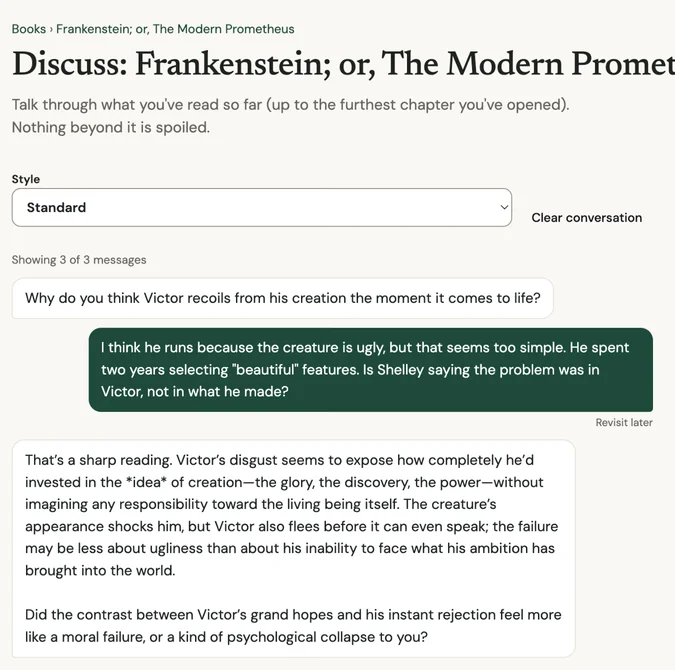
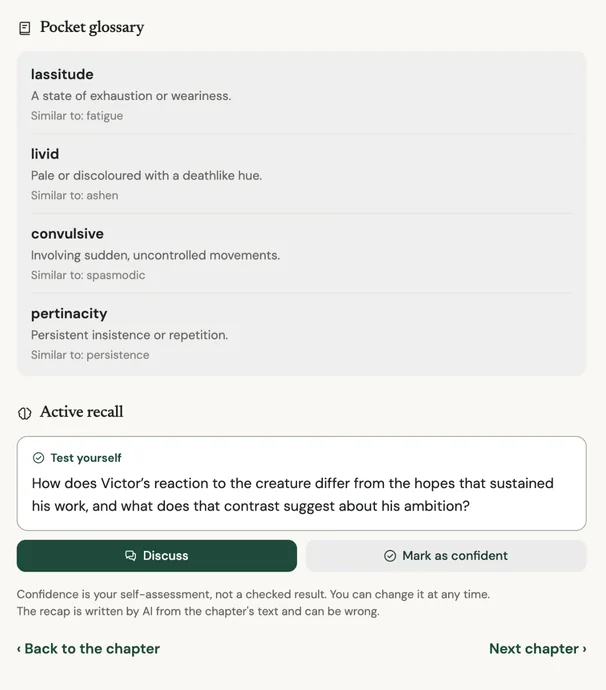
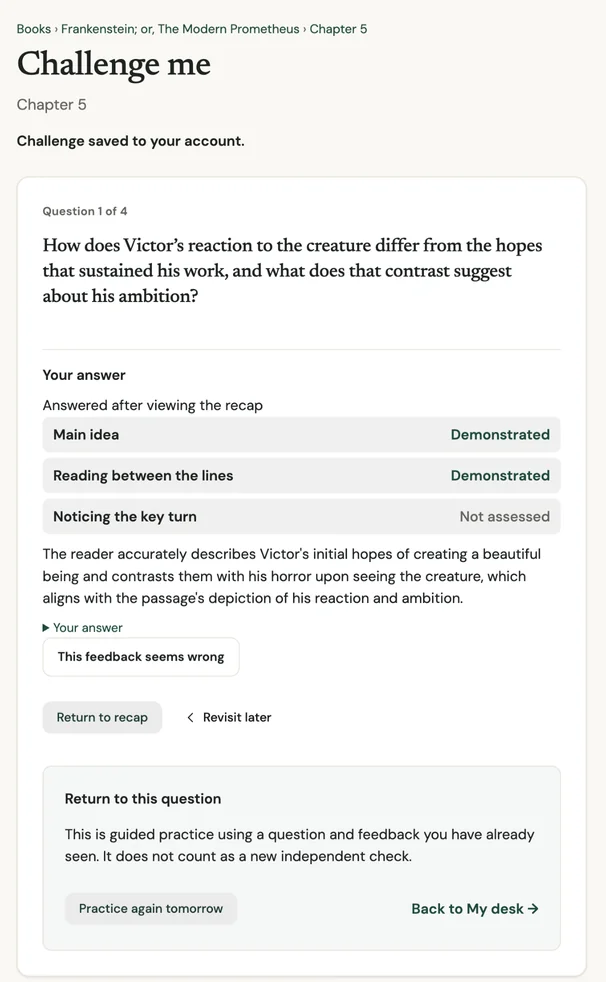
Screenshots from the Parlor Study web app, October 2026, using a demo account. AI replies and assessments can be wrong.
AI can misread a passage, and a quotation alone does not prove an interpretation. When feedback seems wrong, return to the text and explain the disagreement. Parlor’s practice feedback is not a formal grade or a guarantee of improved performance.
You can save thoughts on imported reading and return to confirmed book discussions and practice. The available saving and review controls differ between books and imported material; the FAQ explains the basics.
Commonly assigned books Parlor opens in full, with the reading time for every chapter, so you can plan a chapter and then check you understood it.
The web preview is available by invitation, for ages 13 and up.